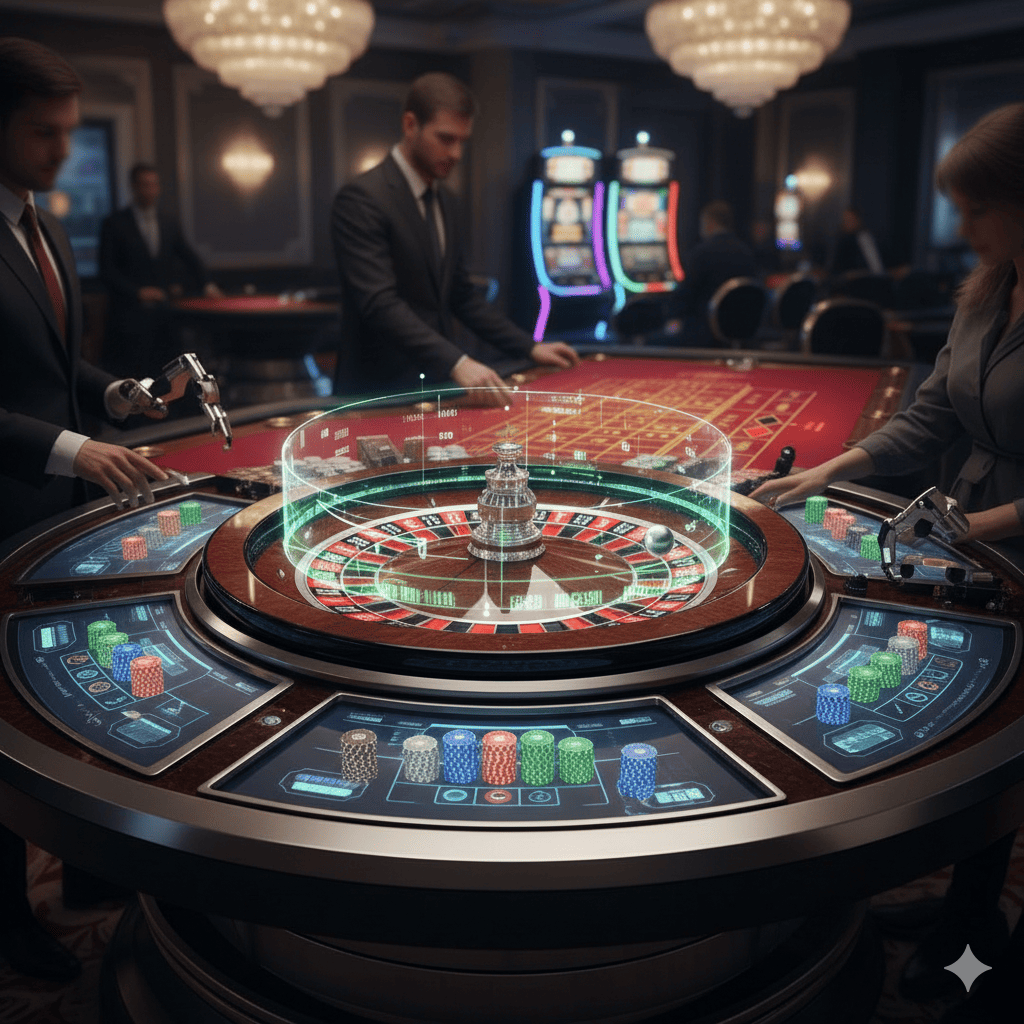
The Evolution of the Pit
The casino floor has always been a theater. From the plush carpets of Las Vegas to the velvet ropes of Monte Carlo, the environment is designed to suspend disbelief. However, as a representative of a forward thinking online casino, I can tell you that the stage has changed irrevocably. We are no longer simply pointing cameras at felt tables. We are building worlds. The transition from standard chroma key technology to fully immersive Augmented Reality (AR) has forced us to completely dismantle our onboarding processes. The phrase AR dealer training is now the cornerstone of our HR department, appearing in every manual and strategic roadmap we publish. This is not just about teaching someone to shuffle cards or spin a wheel anymore. It is about training them to exist in two realities simultaneously without losing their mind or their smile.
When we first integrated AR elements, we thought it would be a cosmetic upgrade. We assumed we could take a veteran croupier, put them in front of the new sensors, and the software would do the rest. We were wrong. The first batch of test streams was a disaster of “clipping” hands, awkward eye contact with invisible assets, and dealers flinching at digital dragons they couldn’t actually see. We realized then that the human element had to be upgraded alongside the software. The result is a rigorous, sometimes exhausting, training regimen that borrows more from method acting and fighter pilot situational awareness than it does from traditional pit boss wisdom.
The Cognitive Load of Dual Reality
One of the first hurdles we face with new recruits is what we call “The Split.” In a traditional live casino setting, the dealer looks at the cards, the table, and occasionally a monitor showing the chat. In an AR environment, the dealer is surrounded by a digital overlay that only the player sees in its full glory, but the dealer must “sell” to the camera.
Managing the Invisible Interface
Imagine dealing a hand of Blackjack. Now imagine that to the player, the cards are flaming meteorites landing on a scorched earth surface. To the dealer, physically, they are just paper cards on a blue table. If the dealer treats them like paper, the illusion breaks. We train our staff to visualize the weight and texture of digital assets that do not exist in their physical space. This requires a massive amount of cognitive bandwidth.
We run drills where dealers must narrate a game while interacting with “phantom objects.” We place markers on the table that represent 3D structures-castles, slot machines, bonus wheels-that will be rendered later. The dealer must reach out and “touch” these markers with the exact velocity and pressure that matches the animation the player sees. If they move their hand too fast, it looks like they passed through the solid object. If they move too slow, the game feels laggy. It is a dance of milliseconds.
The HUD Gaze and Eye Tracking
Modern AR streams often utilize eye-tracking technology to trigger certain visual effects. If a dealer stares at a specific region of the virtual overlay, it might activate a stats window for the player. This means we have to train dealers on where to look, not just for social connection, but for software functionality.
We teach a technique called “The Anchor Gaze.” Dealers are trained to lock their eyes on specific volumetric coordinates in empty space. To an observer in the studio, they look like they are staring at ghosts. To the player at home, the dealer is making eye contact with a floating avatar or a hovering scoreboard. This requires suppressing the natural human instinct to look at movement. If a studio technician walks by behind the camera, the dealer cannot glance. If a light flickers, they cannot flinch. Their gaze is a controller input, and we treat it with the same discipline as a button press.
Proprioception and Spatial Discipline
Proprioception is the body’s ability to sense its location, movements, and actions. In our AR studios, this is the most critical physical skill. The studio is smaller than the world the player sees. A dealer might be sitting in a booth that is physically two meters wide, but virtually, they are sitting on a throne in a massive coliseum.
The Box of Validity
We define a “Box of Validity” for every game. This is the 3D space where the dealer’s hands are allowed to exist. Outside this box, the AR rendering might glitch, or the dealer might clip through a virtual wall. In the past, a dealer could stretch their arms or lean back. Now, those movements might ruin the rendering of a virtual suit of armor they are supposed to be wearing.
Training involves wearing haptic feedback suits that vibrate when the dealer moves outside the safe zone. It is a harsh teacher, but effective. After a week of “buzz training,” the dealers develop a muscle memory that keeps them perfectly centered within the digital architecture. They learn to gesture grandly without extending their elbows beyond the render limit. They learn to pick up cards without occluding the fiducial markers that the cameras need to track the game state.
Interaction with Volumetric Light
Lighting is the enemy of bad AR. If the physical lighting on the dealer does not match the virtual lighting of the environment, the dealer looks like a sticker pasted on a background. Our lighting rigs are dynamic, changing color and intensity based on the game events.
Dealers must learn to “find the light” in real-time. If a virtual dragon breathes fire on the left side of the screen, the studio lights turn orange on the left. The dealer must instinctively turn towards the heat source, shielding their face or reacting to the sudden brightness. If they ignore the light changes, the immersion is shattered. We run “reaction drills” where lights flash randomly, and the dealer must physically respond-wincing, ducking, or leaning in-while maintaining the flow of the card game. It turns the dealer into a reactive component of the lighting engine.
The Acting Curriculum
We used to hire people who were good at math and had nimble fingers. Now, we hire performers. The technical skills of dealing can be taught relatively quickly, but the ability to inhabit a character is harder to cultivate. In an AR world, the dealer is often part of a narrative.
Narrative Consistency
In our “Olympus” themed room, the dealer isn’t just a host; they are a minor deity. They cannot say “place your bets.” They must use script-specific language like “make your offering.” However, they cannot sound like they are reading a script.
We employ acting coaches to work on improvisation. Players in the chat will ask questions that break the fourth wall. “Hey, what time is your shift over?” A standard answer breaks the immersion of the Olympus theme. The dealer must be trained to deflect modern questions with thematic answers without being rude. “Time flows differently on the mountain, mortal,” is a valid response. “I get off at 5 PM,” is not. This requires a quick wit and a deep understanding of the lore we have built around the game.
Emotional Bandwidth in High-Fidelity
AR cameras are often 4K and high frame rate. They capture micro-expressions that standard definition cameras missed. If a dealer is bored, tired, or frustrated, the high-fidelity avatar they are inhabiting amplifies that emotion.
We teach “Micro-Expression Control.” This involves watching slow-motion replays of their own faces while they deal. We point out the split-second frown when a card shoe jams, or the subtle eye-roll when a player complains. In AR, where the dealer might be overlaid with glowing ethereal skin, these human cracks look grotesque. We train them to maintain a “neutral-positive” baseline face that anchors the digital effects properly. It is exhausting work, maintaining a specific facial tension for an hour-long rotation, which is why our breaks are more frequent than in traditional casinos.
Technical Literacy and Troubleshooting
The most beautiful AR setup in the world is useless if it crashes. In the old days, if a shuffler broke, the dealer called the pit boss. In the AR world, if the tracking fails, the dealer is the first line of defense. They are the only human in the loop who can smooth over a digital failure.
Glitch Improvisation
We have a specific module called “Glitch Protocol.” We intentionally crash the AR system during training sessions. The dragon freezes. The cards disappear from the screen. The background turns into a “blue screen of death.”
The dealer’s reaction must be immediate and calming. They cannot look panicked. We provide them with “fallback phrases” and physical actions. If the overlay vanishes, they must immediately switch to “analog mode,” verbally confirming every card and action with exaggerated clarity to reassure players that the game is still fair, even if the graphics are gone. They essentially have to narrate the game for the blind until the system reboots. This requires a deep understanding of the game mechanics, independent of the visual aids they usually rely on.
Understanding the Hardware ecosystem
Our dealers undergo a basic IT course. They need to understand what a lidar sensor is. They need to know why they cannot wear certain fabrics (moiré patterns confuse the cameras). They need to understand latency.
We explain to them that there is a delay between their movement and what the player sees. If they move their hand and say “No more bets” at the exact same time, the audio might arrive before the video due to processing differences, or vice versa. We train a specific cadence: Gesture, Pause, Speak. This “latency buffer” ensures that regardless of the player’s internet connection, the visual and audio cues align reasonably well. It feels unnatural at first-like speaking with an echo-but eventually, it becomes a rhythmic habit.
The Psychology of the Uncanny Valley
The Uncanny Valley refers to the feeling of unease people feel when something looks almost human but not quite. When we mix real humans with high-end AR, we risk falling into this valley. If the digital makeup on a dealer’s face slips just a millimeter, they look like a demon.
Movement Smoothing
To combat the uncanny valley, we train dealers to move in a way that assists the tracking algorithms. Jerky, sudden movements are hard for cameras to track and render over. Fluid, circular movements are easier.
We brought in Tai Chi instructors to help dealers refine their arm movements. We teach them to move through water. When they sweep the table, it is a continuous arc, not a jagged wipe. This “smoothing” allows the AR software to predict the motion vectors more accurately, keeping the digital assets glued tight to the physical world. The result is a mesmerizing, hypnotic dealing style that actually enhances the gambling trance for the player, while simultaneously reducing the computational load on our servers.
Dealing with “Ghosting”
Sometimes, due to network lag, the dealer’s hand might leave a trail or “ghost” on the player’s screen. If the dealer ignores it, it looks like a bug. If the dealer acknowledges it playfully, it becomes a feature.
We train dealers to spot artifacts on their return monitors. If they see ghosting, they are encouraged to slow down slightly or make a joke about “moving faster than light.” This acknowledgement creates a bond with the player. It says, “I see what you see, we are in this glitchy matrix together.” It humanizes the technology. We found that player retention is actually higher when dealers acknowledge tech hiccups with humor rather than ignoring them with robotic stoicism.
The Recruitment Paradigm Shift
The prerequisites for becoming a dealer have shifted entirely. We no longer look for the fastest hands in the west. We look for gamers, streamers, and cosplayers.
Why Gamers Make the Best Dealers
Gamers understand the language of the interface. They know what a HUD is. They understand lag. They are used to interacting with avatars. When we tell a gamer, “The hitbox for the bet is here,” they understand instinctively. When we tell a traditional croupier the same thing, they look confused.
Our interview process now includes a VR aptitude test. We put the candidate in a headset and ask them to organize virtual objects. We measure their spatial reasoning and how quickly they adapt to physics that don’t match the real world. If they get motion sickness, they are disqualified. If they try to lean on a virtual table and fall over, they are disqualified. We need people who can maintain a dual consciousness-grounded in the physical studio, but mentally projected into the virtual lobby.
The Physical Toll and Ergonomics
It would be irresponsible not to mention the physical demands. Staring into green screens and bright studio lights while focusing on augmented monitors causes significant eye strain. The “T-Pose” stance required for calibration can be tiring.
We have redesigned our break rooms to be “low-stimulus zones.” No screens. Soft lighting. Analog books. We encourage dealers to engage in “eye yoga” to reset their focal distance. We also invest heavily in ergonomic footwear and mats, as the dealers are often standing on sensors that cannot be covered by thick anti-fatigue mats used in traditional pits. We have had to commission custom, transparent flooring that provides support without blocking the up-facing cameras used for skeletal tracking.
Security and Integrity in an Augmented World
Regulatory bodies are still catching up to AR gambling. They want to know: “Did the dealer really draw that card, or was it a deepfake overlay?”
The Gesture of Verification
To satisfy regulators and skeptical players, we have integrated “verification gestures” into the training. Before every shoe change, the dealer must perform a specific sequence of hand movements that passes through the digital layer, proving that their hands are real flesh and blood.
They might wave a hand in front of their face to break the AR mask momentarily, or hold a physical card up to a secondary, non-AR camera. This “proof of life” is vital. We train dealers to do this seamlessly. It shouldn’t look like a security check; it should look like a flourish. It is a subtle psychological reassurance to the player that despite the dragons and floating chips, the game is physically real and fair.
Verbalizing the Physical
In traditional dealing, silence is often golden. In AR dealing, silence creates suspicion. We train dealers to verbalize the physical properties of the game. “I am feeling the texture of the new deck.” “This card has a bent corner, let me call the boss.”
By constantly referencing the physical imperfections of the real world objects, the dealer anchors the reality of the game. If everything is too perfect, it looks like a video game (RNG). Players trust the messy reality of physics. The dealer’s job is to be the bridge between the messy reality and the shiny AR overlay. They must verbally highlight the reality to validate the fairness of the outcome.
The Future of AR Dealer Training
As we look toward the horizon, the technology is only getting faster and more intrusive. We are currently experimenting with volumetric capture, where the dealer is recorded by 30 cameras and projected as a hologram into the player’s living room.
Training for Holoportation
This is the next frontier. In a holoportation scenario, the dealer is visible from 360 degrees. There is no “behind the camera.” They cannot scratch their nose, adjust their belt, or slouch. They are on display from every angle.
Training for this involves circular studios. Dealers must learn to address a room that surrounds them, rather than a lens in front of them. It is closer to theater-in-the-round. We are developing training modules that track posture from the back and sides, alerting the dealer if they are “breaking character” from a viewing angle they cannot see.
AI-Assisted Coaching
We are also beginning to use AI to train the dealers. An AI analyzes the dealer’s performance in real-time, measuring their smile intensity, their speech clarity, and their interaction accuracy with AR elements.
After a shift, the dealer receives a heat map of their performance. “You missed the dragon trigger 3 times.” “Your gaze was too low in the second quarter.” This data-driven feedback loop allows for rapid improvement, but it also adds a layer of surveillance that we must manage carefully to avoid burnout. We emphasize that the AI is a tool for mastery, not a whip for punishment.
Conclusion: The Human Anchor
In closing, the transition to Augmented Reality in the online casino sector is not merely a software update; it is a human resources revolution. We are asking young men and women to become pilots of a complex digital-physical hybrid vehicle. We are asking them to be actors, technicians, security officers, and psychologists, all while dealing cards with sub-second precision.
The training programs we have developed are complex, expensive, and constantly evolving. But they are necessary. In a world where anyone can build a digital casino, the differentiator is not the graphics; it is the human connection. The dealer who can look you in the eye through a VR headset, laugh at a glitch, and smoothly guide you through a fantasy world while keeping the integrity of the Blackjack game intact-that is the most valuable asset in our industry.
We are not just training dealers anymore. We are training reality architects. And as the line between the physical and the digital continues to blur, these architects will be the ones who define the future of entertainment. The complexity of their role reflects the complexity of our modern world, where we must all learn to live, work, and play in layers of reality that our ancestors could never have imagined. The green screen was just the beginning. The real game has only just begun.